Open Web Girder Bridge in Railway: Part 1
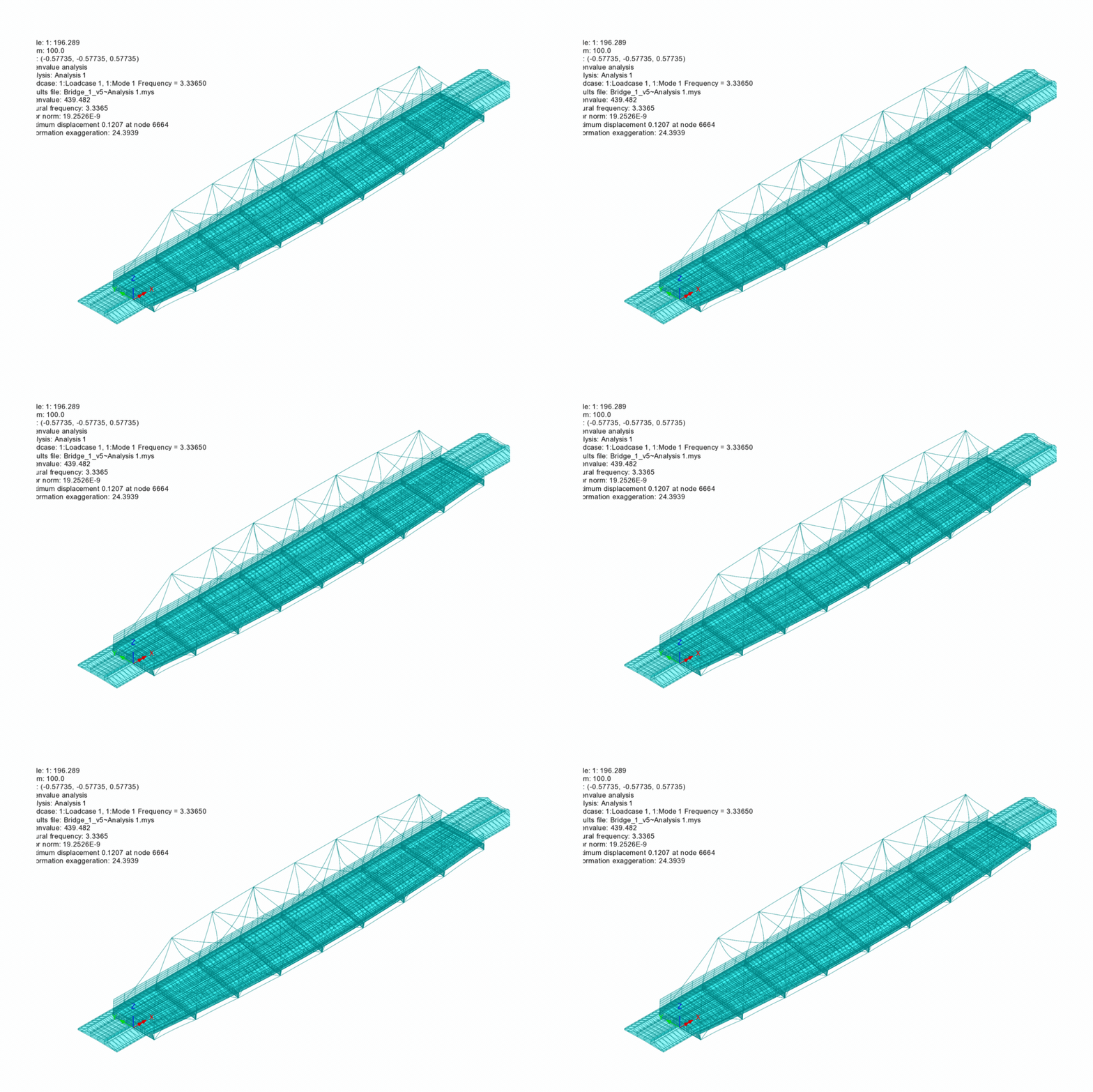
An Open Web Girder Bridge in a railway is subjected to more than the vertical loads generated by passing trains. As railway operations evolve toward higher speeds and increased axle loads, longitudinal forces generated during braking and traction can also influence the bridge’s structural response.
These forces act along the direction of the track and interact with vertical train loads, affecting displacement, stress distribution, and load-transfer behavior. For engineers involved in the design or assessment of an Open Web Girder Bridge in Railway, understanding these effects is an important part of evaluating structural performance.
Why Do Braking & Traction Matter in an Open Web Girder Bridge?
When a train brakes, longitudinal forces are transferred from the wheels through the rail and bridge deck into the structural system. During acceleration, traction forces act in the direction of train movement.
Indian Railway provisions require these effects to be considered alongside vertical loading. In the technical study behind this article, braking force is modeled as 25% of the weight on the braked wheels, while traction is assumed to be 15–20% of the weight on the locomotive’s driving wheels.
Research Designs and Standards Organisation (RDSO). (2017). Indian Railway Standard Code of Practice for the Design of Steel or Wrought Iron Bridges Carrying Rail, Road or Pedestrian Traffic (Steel Bridge Code). Ministry of Railways, Government of India, Lucknow.
For an Open Web Girder Bridge, these forces are not merely additional load cases. Their interaction with the truss geometry, supports, deck, bracing, and rail–bridge load-transfer mechanism can produce different structural responses.
Moving Beyond Simplified Railway Bridge Dynamic Analysis
Traditional empirical approaches can provide useful design checks, but they simplify the actual behaviour of a bridge. Detailed finite element analysis can provide a more comprehensive view of how the structural response changes as a train moves across the span and as train speed increases.
The study develops a 3-dimensional Open Web Girder Bridge model using LUSAS, incorporating geometry, material properties, mesh refinement, and support conditions. Moving-load simulations are performed across train speeds ranging from 20 to 120 km/h.
Three principal loading conditions are investigated:
- Vertical axle loading
- Vertical loading + braking
- Vertical loading + traction
This approach allows the study to examine how longitudinal forces influence the response of the Open Web Girder Bridge rather than treating braking and traction as isolated theoretical loads.
What the LUSAS Analysis Reveals
One important finding is that an Open Web Girder Bridge can respond differently under braking and traction conditions in LUSAS software.
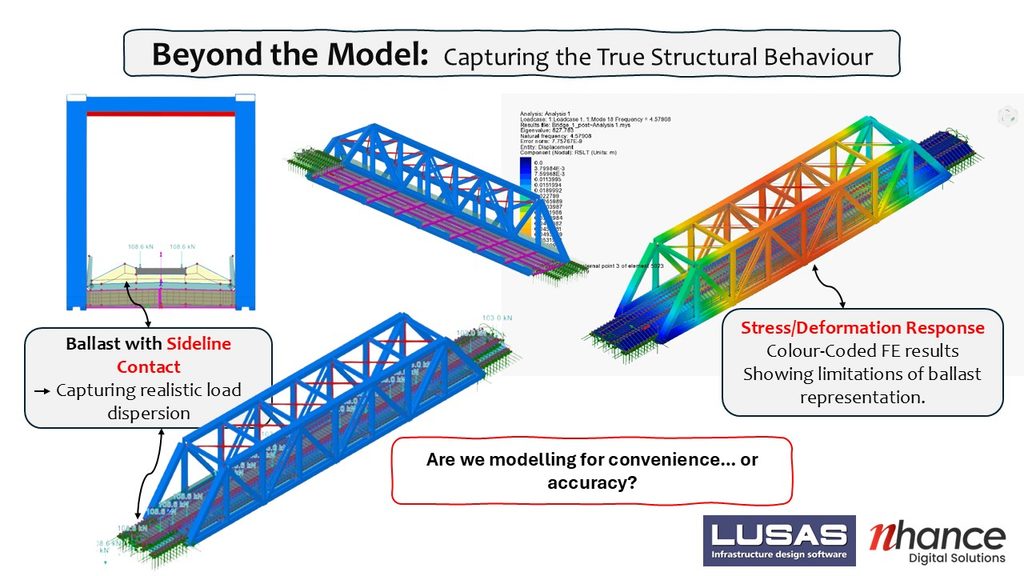
The analysis identifies displacement concentrations around the upper mid-span region of the truss under combined vertical and longitudinal loading. The longitudinal displacement behavior also varies considerably between braking and traction conditions.
The study found that traction produced a substantially larger longitudinal displacement response than braking in the modelled bridge, despite the lower traction-force magnitude used in the loading definition.
The technical investigation also examines deck slab stresses and the influence of ballast modelling. Comparing spring-supported ballast with a simplified ballast representation demonstrates that the modeling approach can affect predicted displacement and load-transfer behavior.
Why Does This Matter for an Open Web Girder in Railway Bridge Assessment?
The study highlights an important consideration for railway bridge analysis: the predicted response of an Open Web Girder Bridge analysis can depend significantly on how train loading, longitudinal forces, train speed and rail–bridge interaction are represented in the model.
For engineers working on railway bridge dynamic analysis design, structural assessment or research, detailed simulation and dynamic assessment of railway bridges can therefore provide additional insight into complex loading scenarios that may not be fully represented through simplified approaches.
Explore the Complete Technical Study
The full technical article goes deeper into the Open Web Girder Bridge model, loading methodology, Moving load analysis of railway bridges, eigenvalue analysis, braking and traction response, ballast modeling, and comparison with the empirical IRS Bridge Rules approach.
Want to see how the complete model was developed and how braking, traction, moving loads, and ballast modeling affected the bridge response?
Download the full technical article to explore the detailed methodology, results, figures, and comparative assessment using LUSAS.
Frequently Asked Questions
Q1. Can LUSAS be used for railway bridge assessment?
Ans. LUSAS can be used for railway bridge assessment, including moving loads, braking and traction forces, displacement and stress response.For complex railway structures, detailed finite element modelling can provide deeper insight than simplified load checks alone.Nhance Digital Solutions supports engineers with LUSAS-based structural analysis and technical solutions for such applications.
Q2. Can LUSAS be used for moving load analysis of railway bridges?
Ans. Yes. LUSAS can perform moving load analysis of railway bridges to study how structural response changes as train loads move across the span.
Engineers can examine factors such as train speed, displacement, stress and load effects within the model.Nhance Digital Solutions can help engineers apply LUSAS for detailed railway bridge modelling and analysis.
Q3. How can braking and traction forces be analysed in a railway bridge?
Ans. Braking and traction forces can be modelled as longitudinal loads alongside vertical train loads to evaluate their effect on the bridge.Finite element analysis can help assess resulting displacement, stress distribution and load-transfer behaviour.With LUSAS and technical support from Nhance Digital Solutions, engineers can develop a more detailed approach to these railway bridge loading scenarios.
Q4. What are the different types of girder bridges?
Ans. Common types include plate girder, box girder, I-girder and open web girder bridges. Each configuration has different structural characteristics and is selected based on factors such as span, loading, construction requirements and project conditions. For railway structures, open web girders are one configuration used for carrying rail traffic loads.
Q5. How is a railway bridge assessed?
Ans. Railway bridge assessment involves studying the structure under relevant loading conditions and checking responses such as displacement, stress, stability and dynamic behaviour. For more detailed investigations, engineers can use finite element and moving-load analysis to study how the bridge responds as train loads travel across the structure.
Q6. What is an Open Web Girder Bridge in Railway?
Ans. Open Web Girder Bridge in Railway uses a framework of interconnected structural members to carry railway loads and transfer them to the supports. Its response depends not only on vertical train loads but also on longitudinal effects such as braking and traction. These effects can therefore be important in detailed railway bridge assessment.