IDEA StatiCa Stiffness Analysis: Facts or Assumptions?
Repeated design iterations.
Unexpected force redistribution.
Connection assumptions don’t reflect real structural behavior.
Structural engineers designing industrial plants, commercial buildings, power projects, metro infrastructure, and other steel structures regularly encounter these challenges. Even when the global structural model is accurate, assumptions about connection stiffness can significantly influence how forces are distributed throughout the structure. Relying solely on pinned or rigid connections may result in conservative designs, unnecessary revisions, or additional verification cycles.
IDEA StatiCa Stiffness Analysis helps engineers evaluate the actual rotational stiffness of steel connections, enabling more realistic structural models and better-informed design decisions.
Why Connection Stiffness Matters More Than You Think ?
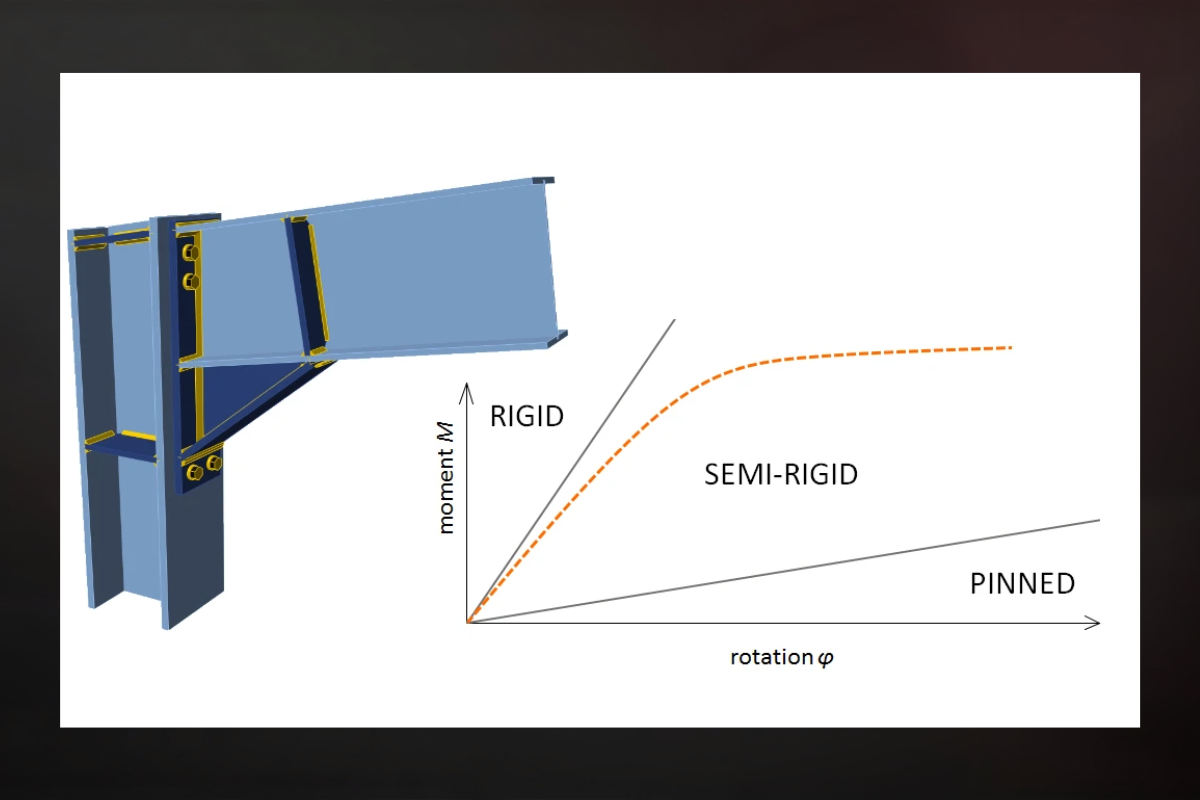
Most structural analysis software requires engineers to define joints as either pinned, rigid, or partially rigid. While these simplified assumptions help create efficient analytical models, they don’t always represent the actual behavior.
In real projects, every connection exhibits a certain level of rotational stiffness. The challenge is understanding how that stiffness affects:
- Force distribution throughout the structure
- Beam and column moments
- Deflection
- Structural stability
- Member utilization
- Overall design economy
When assumptions differ significantly from actual connection behavior, engineers often find themselves revisiting both the analysis model and the connection design, resulting in additional coordination and design iterations.
Connection stiffness and its use in Global Analysis
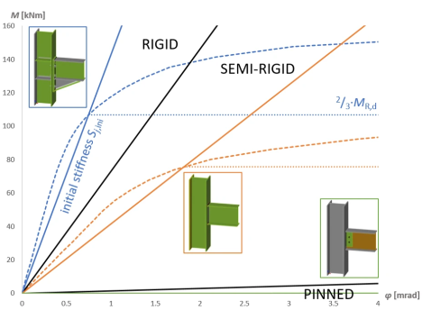
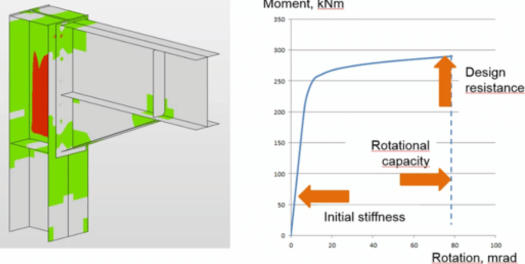
The moment-rotation diagram dictates the distribution of internal forces within the entire structure. The initial stiffness of a joint ultimately determines its classification. Notably, internal forces do not change significantly when a joint remains in the completely pinned or rigid regions; however, they change rapidly
within the semi-rigid region.
Because stiffness is evaluated on a logarithmic scale, a connection’s stiffness can change by a factor of 100 with very little structural effect if it remains safely within the pinned or rigid zones. Properly accounting for the actual semi-rigid stiffness limits structural analysis errors to 5% for internal forces (ultimate limit state) and 20% for deformations (serviceability limit state).
What is IDEA StatiCa Stiffness Analysis?
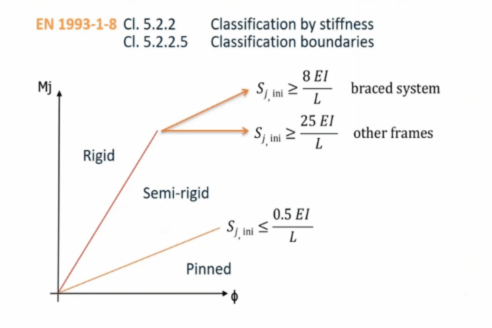
In IDEA StatiCa, stiffness analysis produces a detailed load-deformation diagram—most importantly, the moment-rotation diagram. Based on this curve and selected national standards, the joint is classified into one of three categories:
- Rigid: Joints with an insignificant change in the original angles between members.
- Semi-rigid: Joints that are assumed to provide a dependable and known degree of flexural restraint.
- Pinned: Joints that do not develop bending moments.
The result is a calculated stiffness characteristic that can improve the accuracy of the global structural analysis model.
How It Fits into Your Structural Design Workflow ?
From Analysis to Realistic Connection Behavior
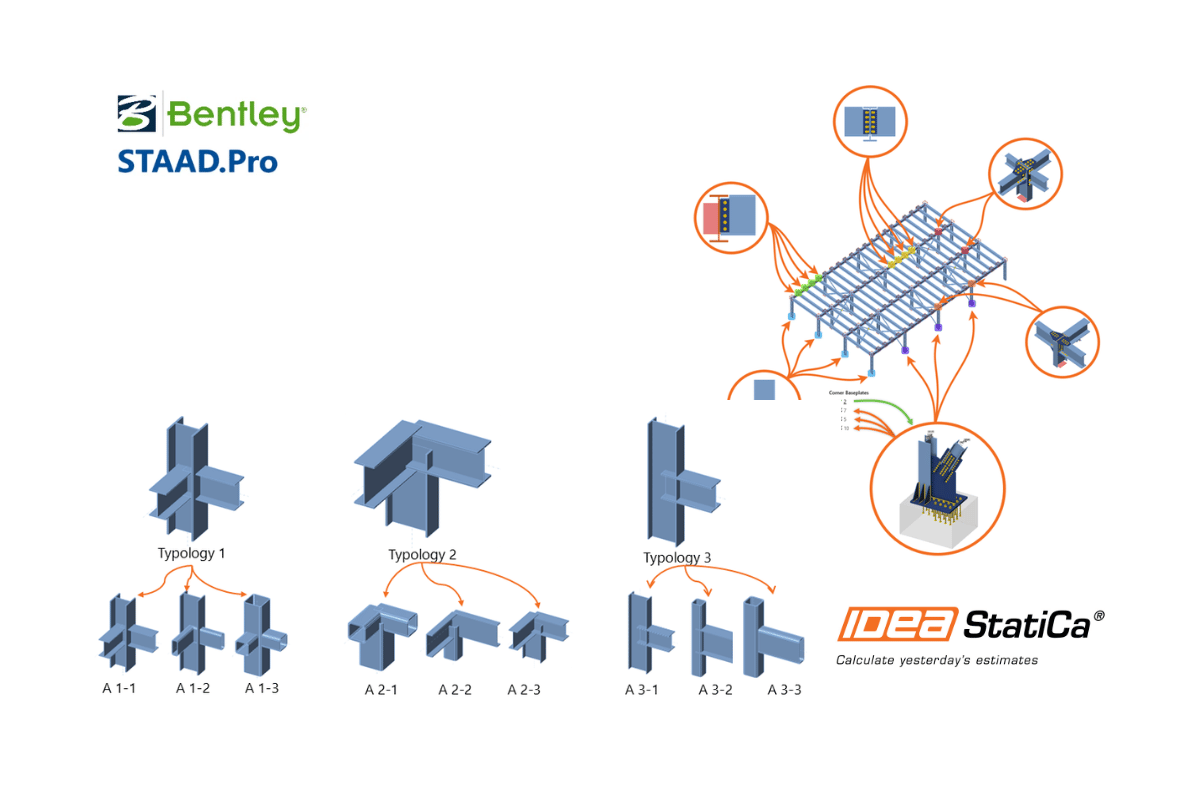
In many engineering offices, the workflow begins with structural analysis software such as STAAD.Pro, ETABS, SAP2000, RFEM, or other commonly used platforms. Once member forces are established, individual connections are designed separately.
However, if the designed connection behaves differently from the assumed model, engineers may need to update the analysis, revise member sizes, and repeat the verification process.
IDEA StatiCa helps reduce this disconnect by allowing engineers to evaluate the actual stiffness of the designed connection and, where required, feed those results back into the structural model for improved accuracy.
This creates a more integrated workflow between structural analysis and connection design.
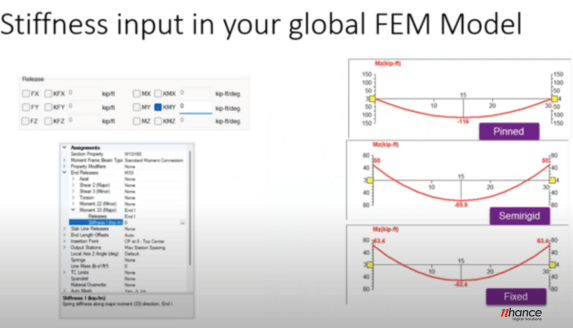
How do you put rotational stiffness into your FEA model?
To correctly implement the rotational stiffness derived from your connection design back into your FEA model, you should generally use the initial stiffness values provided by the IDEA StatiCa output. Depending on the classification, apply the following to your global FEA software:
- Rigid joints: Keep the structural members fully merged at the node.
- Pinned joints: Add a perfect pin (moment release) in the global model.
- Semi-rigid joints: Apply the initial stiffness Sj,ini as a rotational spring if the design moment Mj.Ed does not exceed 2/3 Mj.Rd . If Mj.Ed>2/3Mj.Rd, utilize the reduced secant stiffness calculated as Sj.ini/n
Where Stiffness Analysis Adds the Most Value
Industrial Facilities and Process Plants
Steel pipe racks, equipment support structures, and heavy industrial frames often experience complex loading combinations.
Commercial Buildings
Multi-story steel buildings require accurate modeling of beam-column connections, particularly where semi-rigid behavior influences lateral stability and drift calculations.
Infrastructure Projects
Metro stations, bridges, elevated structures, and transportation facilities frequently contain numerous repetitive steel connections.
Power and Oil & Gas Projects
Projects in these sectors demand strict compliance with design standards while managing heavy loads and complex structural systems.
Benefits of Using Steel Connection Stiffness Analysis Software
Replace Assumptions with Engineering Evidence
Rather than categorizing joints as simply pinned or rigid, engineers can quantify actual connection stiffness based on geometry and detailing. This provides a stronger engineering basis for design decisions.
Improve Accuracy of Global Structural Models
Connection stiffness directly influences force distribution and member behavior. Using calculated stiffness values helps create structural models that more closely represent actual field conditions.
Reduce Rework and Design Iterations
One of the most significant benefits is the reduction of repeated analysis cycles. Engineers can identify stiffness-related issues earlier and minimize redesign efforts later in the project.
Optimize Member Sizes
When realistic stiffness is considered, the force distribution often differs from that predicted by simplified assumptions. This may allow engineers to optimize member sizing, resulting in more economical structures.
Better Understanding of Semi-Rigid Behavior
Many real-world steel connections fall between the pinned and rigid extremes. IDEA StatiCa allows engineers to clearly understand and quantify this semi-rigid behavior instead of making conservative assumptions.
Reliable Code-Based Verification
IDEA StatiCa combines advanced analysis methods with verification procedures aligned with major international design standards, helping engineers maintain compliance while evaluating realistic behavior.
Integration With Existing Workflows
The software integrates with widely used structural analysis programs, allowing engineering teams to incorporate stiffness verification into their existing design processes without major workflow changes.
Better Insight Into Structural Behavior
Engineers gain a deeper understanding of how connections influence the performance of the entire structure, leading to more informed engineering decisions throughout the project lifecycle.
Enhanced Project Confidence
By reducing uncertainty about connection behavior, engineers can move from assumption-based decisions to analysis-supported decisions, improving confidence in the final design.
Better Engineering Starts with Better Connection Insights
Steel connections rarely behave as perfectly pinned or perfectly rigid. Verifying actual connection stiffness gives engineers a more realistic understanding of joint behavior, helping improve analysis accuracy, reduce design iterations, and make more informed design decisions.
With IDEA StatiCa Stiffness Analysis, engineering teams can evaluate realistic connection behavior and incorporate accurate stiffness data into their structural design workflow.
As the Authorized IDEA StatiCa Partner in India, nhance Digital Solutions helps structural engineering teams implement IDEA StatiCa with software licensing, product training, implementation guidance, and dedicated technical support.
Ready to improve the accuracy of your connection design? Contact nhance Digital Solutions to schedule a personalized IDEA StatiCa demonstration or discuss the right licensing option for your organization.
Frequently Asked Questions
Q1. What are the leading software solutions for steel connection stiffness evaluation?
Ans. IDEA StatiCa is one of the leading solutions for evaluating steel connection stiffness. It enables engineers to determine whether a connection behaves as pinned, semi-rigid, or rigid, and provides realistic moment-rotation stiffness data that can be used to improve the accuracy of global structural models.
Q2. What are the best software tools for stiffness analysis in structural engineering available in India?
Ans. IDEA StatiCa is one of the best software tools available in India for stiffness analysis of steel connections. It helps engineers evaluate the actual behavior of joints by generating moment-rotation curves. This enables more accurate global structural models, realistic load distribution, and optimized steel designs, reducing the reliance on conservative assumptions. In India, you can purchase the Ideastatica software solution from nhance Digital Solution, an authorized Ideastatica partner.
Q3. How to perform stiffness analysis using finite element software
Ans. IDEA StatiCa simplifies stiffness analysis by automatically evaluating the real behavior of steel connections using finite element analysis. Engineers can model the connection, apply loads, and run a stiffness analysis to generate moment-rotation curves and determine whether the joint behaves as pinned, semi-rigid, or rigid. The resulting stiffness values can then be used to improve global structural models, leading to more accurate load distribution and optimized designs.